Research
Job Market Paper
Electricity Transmission Lines and Land Development in the Pacific Northwest (Latest version)
Abstract
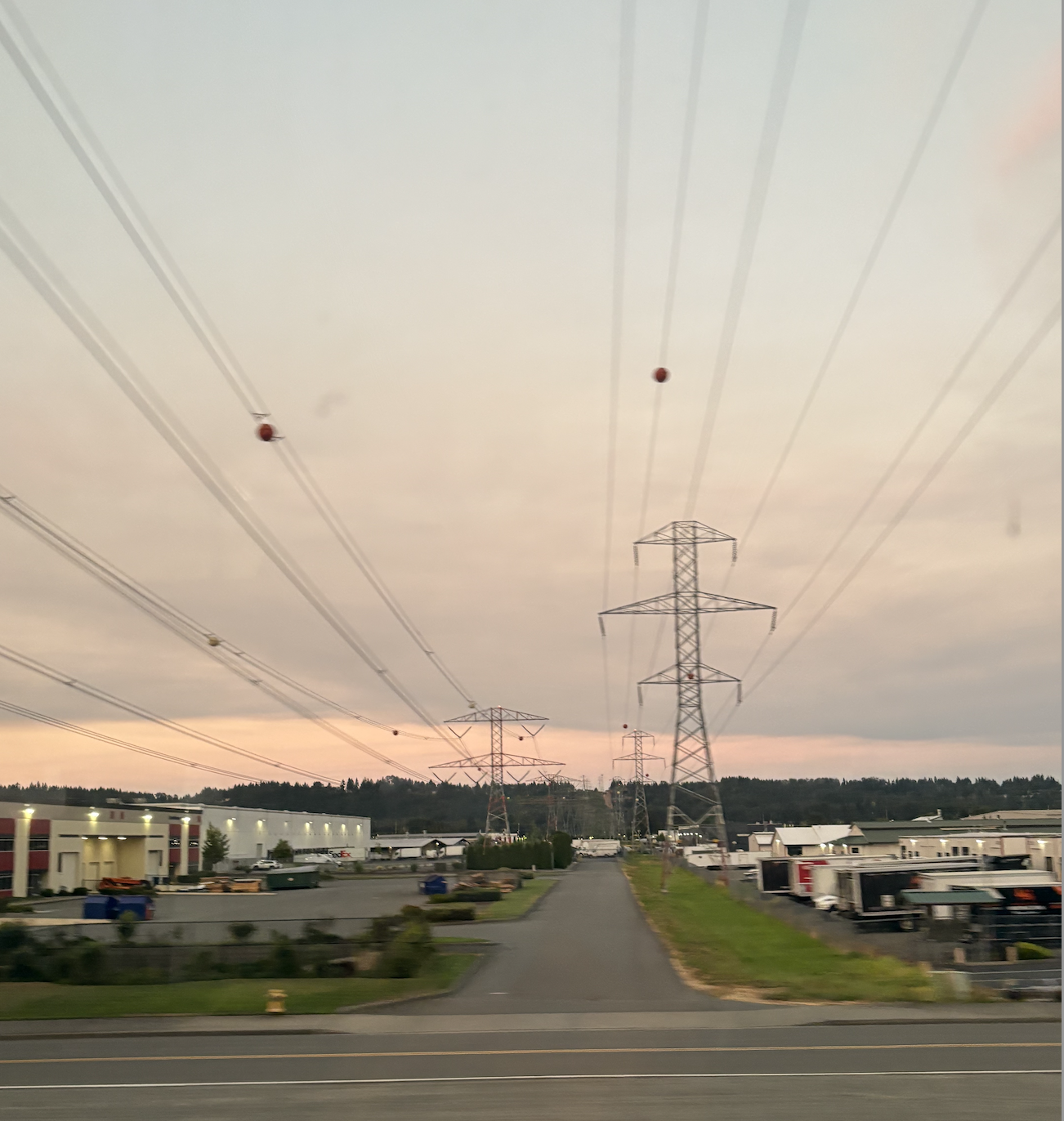
Multiple national-scale electricity transmission studies have pointed out that expanding transmission significantly is the most cost-effective way to serve the rapidly increasing electricity demand in the long run while supporting more clean energy resources to generate electricity. Yet, it is extremely difficult to build a new transmission line. Landowner resistance to granting a transmission line right-of-way (ROW) can slow down or kill a transmission project. In this paper, I study the build out of electricity transmission lines in the Pacific Northwest by Bonneville Power Administration from 1938 to the early 1940s. I provide the first-of-its-kind estimate on the impact of ROW resulted from building a new transmission line after 60 years up to the present day. Combining public records of ROW tracts, newly digitized historical and contemporary property assessment records, and newly geo-referenced parcel ownership maps, I find that having a ROW on a parcel reduces parcel value per acre by 19.14% relative to what it would have been if absent a ROW. The potential mechanism is the difference in land development between parcels from which ROWs were acquired and nearby parcels from which no ROWs were acquired. The impact varies across lines, driven by lines' locations and whether the ROWs were acquired through an easement or title ownership. As historical rural lands have transformed into today's suburbs, easement provides opportunities to develop the ROW lands, while a line’s location influences the types of land use that develop after the line is built. Comparing the estimated impact of ROW with the average ROW compensation, the implied annual rate of return that could fully compensate for the long-run losses in parcel value ranges from 7.3% to 10.7%, which suggests that at the time of ROW acquisition, there was considerable uncertainty regarding possible future returns from supporting transmission infrastructure. The wealth impact could be a net positive depending on how compensation monies were invested.
Working Paper
Effects of Charging and Discharging of Battery Storage on California’s Wholesale Electricity Prices (under review)
Abstract
The total battery capacity on California's grid increased tenfold from 2021 to 2023. Estimating the price effects of batteries' charging and discharging is crucial for understanding the effects of battery storage on the wholesale electricity market. In this paper, I regress hourly real-time electricity prices on the daily total battery charging over the charging hours, or the daily total battery discharging over the discharging hours with a panel fixed effects IV model. I find that when batteries discharge one more MWh over the discharging hours, the price in Hour 20 (7pm-8pm) decreases by 0.37 cents/MWh, which equals $23.87 when multiplying by the average amount of discharging over the three years. No effects are found in hours other than Hour 20. In addition, price effects vary by years, and exist in different hours in different years. The price decrease in Hour 20 can be huge if only looking at 2023, which is 1.2 cents/MWh, or $131.46. I also discuss where batteries' energy could come from. I discover a competition between on-peak natural gas generators (e.g., combustion turbines and steam turbines) and batteries' discharging in some of the evening peak hours (e.g., Hour 20 and 21), where the generation from these gas generators would go down as batteries increase discharging. The total generation from natural gas, however, has a positive association with batteries' discharging, reflecting that combined-cycle gas generators, not for on-peak, have increasingly been used as part of the base load fleet to meet demand.
Work in Progress
Transmission Outages, Wholesale Electricity Prices, and Interregional Transfer Capability
Abstract
Transmission capability on an electric grid can change constantly, affecting electricity generation and consumption while causing price differences across places. In this paper, I estimate the costs of reducing transfer capability between regions using auto transmission outages from 2016 to 2022 on the Malin intertie, which is used to transfer power between California and the Pacific Northwest. I combine the anonymized TADS data from NERC and CAISO's public transmission outage data and find that the directional price spread from the importing to the exporting region responds fairly quickly among import outages, and increases by $65.42/MWh 40 minutes after outage starts. For export outages, the responses show up very late, with an average of $39.3/MWh within 15 minutes after outage has begun for six hours. I then calculate the incremental welfare loss caused by an outage, assuming that the lost in power flows equals the outage-reduced lost in transfer capability. I find no robust evidence of welfare loss from export outages, but the welfare loss from import outages is positive. Comparing with a time-equivalent carrying cost calculated from a CAISO project designed to increase import capability, I show that the import welfare loss is almost half of the equivalent cost, suggesting that lowering outage-related costs alone may not be enough to justify expanding interregional transfer capability.
Rethinking Cost Components of Retail Electricity Prices: A Panel Regression Approach
Abstract
Distortions in the retail electricity market bring challenges to set prices equal the short-run social marginal costs of providing electricity. Justifications are often made case by case as to whether we should include the costs of capacity in the short-run private marginal costs. In this paper, I test if it's reasonable to do so with a fixed effects panel regression where I use utility fixed effects to capture capacity costs. Using a panel of utility level electricity prices and costs across US from 2014 to 2016, I find that utility fixed effects don't have statistically significant impact on the short-run pmc, supporting the assumption that the short-run pmc is correctly measured by including only wholesale electricity prices and costs from distribution losses.
Storm Recovery and Grid Resiliency (with Niaoniao You)